Make a Stash Live Again Git
Curt-Lived Characteristic Branches
This branching model was facilitated with the appearance of very lightweight branching that came with Git and Mercurial in the mid-2000's, though there is show that Google were effectively doing the same in their Monorepo for some years before.
Either as branching directly off principal, or in a fork of the whole repository. These branches are destined to come back as "pull requests" into the chief/trunk.
With the Pull Request (and code review) accelerate, the cutting-off point for squad sizes that graduated from "direct to the trunk" to brusque lived feature branches moved lower. While it was upward to 100 earlier Git's lightweight branching, information technology is now up to 15 people. With 16 or more, the squad is more productive with short-lived characteristic branches, and corresponding CI daemons verifying those in advance of commits landing in the torso.
One fundamental rule is the length of life of the co-operative before it gets merged and deleted. But put, the co-operative should just last a couple of days. Whatever longer than two days, and there is a hazard of the branch becoming a long-lived feature branch (the antithesis of body-based development).
Another fundamental rule is how many developers are immune besiege on a brusk-lived feature branch. Another simple answer: the programmer count should stay at one (or two if pair-programming). These short-lived feature branches are non shared within a squad for full general development activity. They may be shared for the purposes of lawmaking review, but that is entirely different to writing product lawmaking and tests.
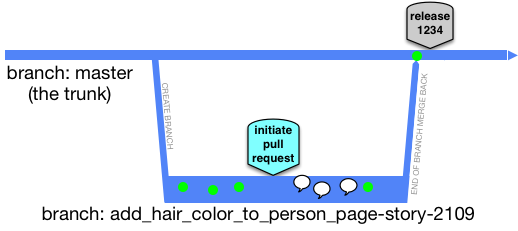
Sometimes the customs calls these 'task' or 'topic' branches, instead of long-lived feature branch.
Merge directionality
Brusk-lived feature branches are real branches and merge is a first grade concept. In the stitch to completing work on the brusque-lived feature branch, you volition need to bring it upward to date with primary (body). That is an effective merge whichever fashion yous do information technology. Await at the co-operative at this moment, it may announced to be much younger than it was before that functioning. The changes have to now become back to chief (body) in some other merge performance. In GitHub, for 'pull requests' (or equivalent in other platforms), the user interface may handle that last merged back for you, and fifty-fifty go as far equally to delete the short-lived feature branch.
To recap: merges to the curt-lived feature co-operative are immune to bring information technology closer to HEAD of master (body). Merges to master (trunk) are allowed only as part of endmost out the brusque-lived feature co-operative (and just before deleting it).
Two developers meantime doing short-lived characteristic branches
Say ii features are beingness worked on concurrently: features X and Y. Both will take a mean solar day to complete, and two developers are working independently on them. Or 4 developers if pair-programming is that team'due south way. The reality of the merge back to master/body, before the deletion of the brusque-lived feature branch, is that the a merge of changes from primary/trunk is frequently needed, earlier the merge to master/trunk.
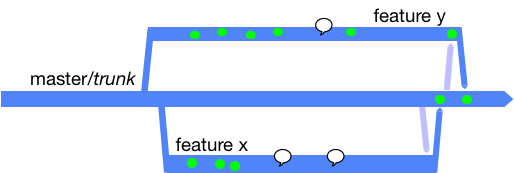
Workflows include:
- Attempt to merge to main/trunk and if that's blocked do a merge/pull from chief/torso earlier attempting the button again.
- Do a speculative merge/pull from main/body before attempting any push to chief/trunk.
The latter leaves no trace if in that location's zip to merge in from the other branch.
Workstations included
Really though Developers work on their ain workstations. That is both for their "working copy" also as their local Git clones consummate with branches:
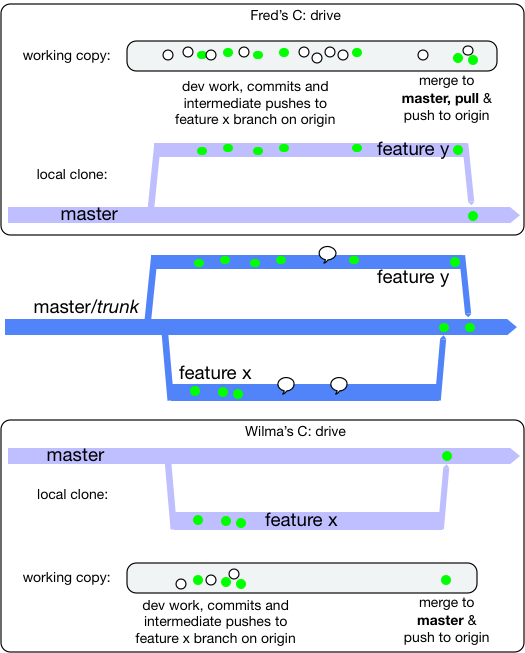
The white dots are only general development work (salvage files from the IDE), and the green dot is the same but validated by a local build that passes and a possibly a local commit.
While each developer works, they maintain a local clone of the primary/torso and their own short-lived feature branch only. Indeed for a period of time, their brusk-lived feature branch may non notwithstanding exist in the shared origin repo.
Personal preferences
At some point, the short-lived feature branch has to exist brought correct upwardly to engagement with primary (torso) in a merge operation before the result being merged dorsum to body (and the co-operative deleted). There are a number of approaches for this, and while teams may have a policy, some teams leave it to personal preference for the developer.
Git stash
Some people exercise git stash before git pull before git stash pop. There'south a adventure that when you popular your working copy may exist in a merge clash situation that has to be resolved before you progress. This way volition always event in your alter beingness a single commit, at the Caput of the branch (equally Subversion would ever practise).
Git rebase
Some people do git rebase. Refer to a well written Atlassian certificate on this  also as one from ThoughtBot that talks well-nigh
 squash too. Even with this model, yous may come across a merge clash, and accept to resolve that locally before you tin can push the effect anywhere, or exercise further merges (to master hopefully).
Pitfalls
Working towards a pull request tin can sometimes make you await past the power of streaming a series of small commits into trunk for the do good of all. High-throughput XP teams from the end of the ninety'southward onward would stream tens of commits a day (per pair) into the trunk. Each commit would exist an incremental stride forward and able to get alive as is, were the squad to change plans to do and so. A mistake in thinking for this fashion of working, is i pull-asking for ane Agile story/card (and no more). Getting out of that mind trap would exist to exercise (say) a pull-request for refactoring and see that integrated/merged into the trunk, then a pull-request for a slice of new functionality (and integrated into trunk), then mayhap some other refactoring (torso integrated again). And for those three pull-requests they shared the same Story/card clan, but maybe had different short-lived branch names - each of which was deleted after merge/integration.
Breaking the contract
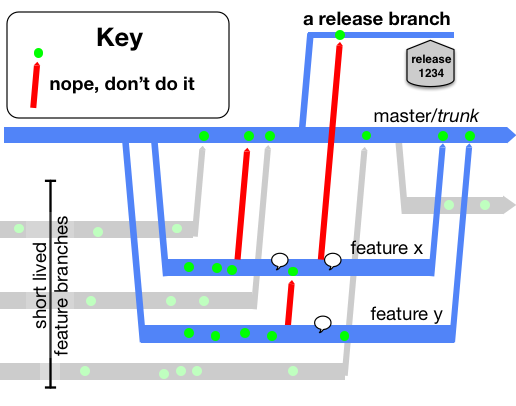
If you merged the part-complete brusque-lived feature branches to anywhere else, then you have broken the contract of trunk-based evolution. For curt-lived feature branches, these are not allowed:
- intermediate merges to master (trunk) - at least where the commit was not able to go alive on its own
- merges (intermediate or not) to other people'south short-lived feature branches
- merges (intermediate or not) to any release branches (if you have them)
- variations of #two that are directly from/to the developers clone on their workstation
- other developers joining yous on your curt-lived feature branches - at least who are non your pair-programming partner.
Alternatives to curt-lived feature branches
In that location is a more traditional alternative for smaller teams: Committing direct to the trunk. Many people even so prefer this way of working, and if the whole team tin do it without blowing up the build server, and then great job team.
There is also the patch-review way of working that was outlined in Google's use of Mondrian (2006), and consequentially delivered for non-Google teams with open up source tools Gerrit and Rietveld (2007/8).
These two alternatives, too equally brusk-lived feature branches are compared in Styles and Merchandise-offs.
References elsewhere
show references
Source: https://trunkbaseddevelopment.com/short-lived-feature-branches/
0 Response to "Make a Stash Live Again Git"
Post a Comment