Whidden T Levitt M 1990 the Art and Science of Sails St Martins Press New
The Art and Science of Sails
Buy the Book
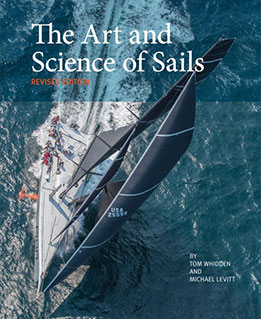 This is not your parents' Art and Science of Sails, written by Tom Whidden and Michael Levitt and published in 1990 by St. Martin'south Press. The first edition was a Main Selection of the Dolphin Book Club. The Second Revised Edition is published by North Sails Group, LLC and Seapoint Books + Media and written by the same duo. What a difference 26 years makes! Today there are ane-piece sails made over a 3D mold in the shape they will presume in the wind. Sail plans accept radically evolved to fractional rigs, fat-head mains, and non-overlapping jibs. That is true for racing sails and sailors as well as cruising sails and cruisers. Thus, 90 percent of the text is new, equally are nearly all of the more 100 photographs and technical illustrations.
The authors focus on circulation as they did in the first edition, merely now come at it from a unlike management. And for the first time anywhere, they attempt to quantify its furnishings. Where the wind speeds upwards and why as information technology passes over a sail program, and where it slows down and why. Circulation theory is familiar to aerodynamicists for at least 100 years and is argued about by sailors at least since 1973, when the late Arvel Gentry loosed his theories on the sailing earth. Gentry was an aerodynamicist at Boeing by day and a sailor on the weekends. And the theories used to explicate why airplanes wing were at odds with the theories of why sailboats sail to weather and what the slot actually does.
Whether you believe in the theories or not, they take had a profound event on sails, sailing, and even yacht pattern.
This is not sails—or sailing—fabricated easy. This is unapologetically a serious book for serious sailors, even though the commencement sailor will learn much. And, information technology celebrates the centuries-old beauty of the sport of sailing along with the fascination of the technology of sails through stunning photos and illuminating illustrations.
- Why partial rigs, fat-head mains, and not-overlapping jibs accept come to predominate.
- Why and how leech twist tin can exist a canvass-trimmer's best friend.
- Why a yacht designer positions the mast, keel, and rudder to create some weather helm.
- Why the safety-leeward position is advantageous relative to the entire fleet, not just to the boat you tacked beneath and forward of.
- Why a mainsail's efficiency is improved with added upper roach, beyond the value of the actress area.
- Why the miracle of upwind sailing is not that at that place is so much lift simply so trivial drag.
- Why, when sailing upwind, the main is always trimmed to a tighter angle than the jib.
- What a polar diagram tells us or why tacking downwind is almost always faster than sailing directly to a mark.
In that location is as well an in-depth look at the wonders of material utilization—not simply materials. And the final three capacity are a users-guide to mainsails, headsails, and spinnakers.
Tom Whidden is president and CEO of Due north Engineering Grouping, which includes North Sails—and since the 1970s has been and continues to be the largest sailmaker in the world. Whidden is an America'southward Cup sailor who has won the Cup three times: 1980, 1986-87, and 1988, primarily as tactician for Dennis Conner. Whidden is in the America's Cup Hall of Fame. He is the author of three books on sails and sailing.
Michael Levitt is the writer of fourteen books, too equally the former communications director of the New York Yacht Club and a erstwhile editor at such publications as Nautical Quarterly (which won a National Mag Award for Design), Sailing Earth, and Yachting. His volume America's Cup 1851-1992 – the Official Record won a Benjamin Franklin Award as the outstanding book in the Outdoor Recreation category as presented by IBPA in 1993.
"A fascinating expect at the science and history that has led united states of america to today'south highly technical world of sailmaking. The book does a wonderful job of explaining the physics behind both trimming of sails and state-of-the-fine art sailmaking." – Bora Gulari, two-time Moth World Champion and U.S. Sailing Rolex Yachtsman of the Year.
"Tom Whidden and Michael Levitt'due south book is a clear, reliable guide to getting the most out of your sails, an essential component to adept seamanship whether you're cruising or racing." —John Rousmaniere, author, The Annapolis Book of Seamanship.
Praise for the Outset Edition of The Art and Science of Sails.
"The book is gracefully written and deserves to exist a archetype." —Sailing World magazine.
"I've known Tom Whidden for quite a while since he crewed for me on the 12-Metre Nefertiti. He has always been a pupil of the technical and business aspects of sailmaking. Whidden has a common-sense approach gained from hands-on ocean racing experience." — Ted Hood, the belatedly sailmaker, yacht designer, boatbuilder, marina programmer, winning America'due south Cup skipper, Yachtsman of the Twelvemonth, and industry leader.
"Whidden and Levitt know as much about sails as anybody alive, and they testify it in this volume. I wish I'd had information technology to read during my 150 days around alone in American Promise." —The late Dodge Morgan, who in 1986 was the first American to sheet solo around the world nonstop— in 150 days, cutting the prior record of 292 days about in half.
"I'grand sure the volume volition become must reading for anyone who is genuinely interested in knowing why sails work the way they practice." —Charles Mason, quondam executive editor of Sail magazine
Source: https://www.seapointbooks.com/books/content/art-science.html
0 Response to "Whidden T Levitt M 1990 the Art and Science of Sails St Martins Press New"
Post a Comment